
AC Replacement in Post Falls, ID
Is your air conditioner struggling during hot North Idaho summers? We connect homeowners across Post Falls and Kootenai County with independent, licensed HVAC professionals for reliable cooling replacement, heat pump upgrades, and in-home replacement evaluations.
- 100% Free Referral Service
- ACCA Manual J Sizing
- Northern SEER2 Compliant
Request a Quick Estimate
Connect with independent local pros serving Post Falls & Kootenai County
What AC Replacement Entails for North Idaho Homes
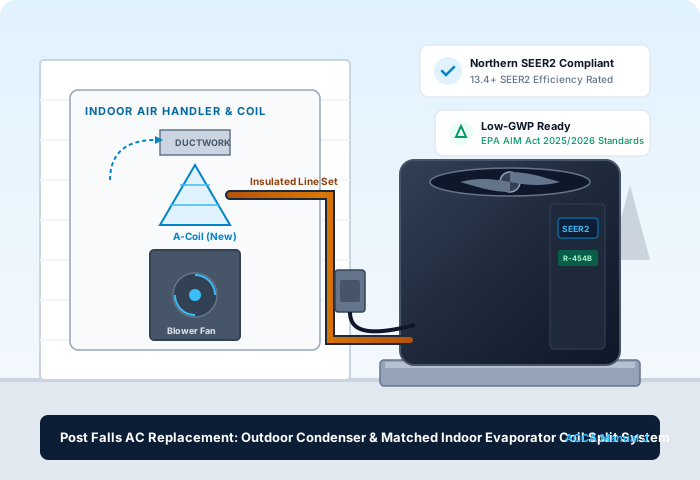
Replacing an air conditioner is more than merely swapping out a metal box in your yard. In Post Falls, where summer temperatures regularly reach into the high 80s and 90s across the Rathdrum Prairie, a properly planned central AC replacement requires balancing the outdoor condensing unit with the indoor evaporator coil and verifying your home's air distribution system.
Many residential neighborhoods developed throughout Post Falls in the late 1990s and early 2000s—including communities like Montrose and Fieldstone—are now reaching the 15- to 22-year mark on their original builder-installed cooling systems. As older units lose efficiency or suffer refrigerant leaks, modern replacements deliver vastly improved electrical economy, quieter operation, and compliance with updated environmental refrigerants.
When an independent HVAC technician evaluates your property for a full cooling system replacement, they verify ductwork static pressure, inspect electrical disconnects, and ensure the new system adheres to Idaho's mechanical code requirements.
Key Components Replaced in a Full Central System
- Outdoor Condenser: Houses the compressor, condensing fan, electrical controls, and heat-rejection coil.
- Indoor Evaporator Coil: Installed directly atop or adjacent to your furnace/air handler to extract heat and humidity from indoor air.
- Refrigerant Line Set: Insulated copper tubing linking outdoor and indoor components, thoroughly flushed or replaced for new low-GWP refrigerants.
- Digital / Smart Thermostat: Calibrated for modern staging or variable-capacity communication to maximize SEER2 efficiency.
- Code Upgrades: Electrical disconnect box, equipment mounting pad, and condensate drain line safety float switches.
Signs It May Be Time to Replace Your Cooling System
Recognizing early indicators of system failure allows homeowners to schedule replacements proactively, preventing sudden breakdowns in the middle of a July heat wave.
Age Exceeding 12 to 15 Years
Even well-maintained central cooling units in Kootenai County have an operational design lifespan of approximately 12–17 years. Once past this threshold, critical components like compressors and blower motors suffer substantial metal fatigue.
Review replacement cost factors →Spiking Summer Electric Bills
If your summer power bills from Avista Utilities or Kootenai Electric Cooperative are climbing despite similar weather conditions, your condensing unit is likely losing compression efficiency and drawing excess electrical wattage.
Compare SEER2 efficiency ratings →Phased-Out R-22 or Leaking Refrigerant
If your existing system relies on discontinued R-22 (Freon) or has developed an evaporator coil leak, recharge costs can be financially impractical. Modern replacements operate on legal, environmentally compliant refrigerants.
Speak with a local professional →Loud Grinding, Buzzing, or Clanking
Unusual mechanical noises frequently indicate a dying condenser fan motor, failing internal compressor valves, or severe electrical arcing in your contactor switch.
Call (208) 555-0199 for diagnostic help →Inability to Maintain Set Thermostat Temperatures
When your unit runs continuously throughout the afternoon without cooling your living spaces below 76°F–78°F, the compressor may have lost mechanical capacity or the system is severely mismatched to your home's current heat load.
Learn about multi-level cooling →Frequent Short-Cycling
A unit that turns on and shuts off every few minutes strains electrical contactors and capacitors without removing indoor humidity. This often indicates wrong sizing or internal sensor failure.
Explore professional installation →AC Replacement vs. AC Repair: The $5,000 Rule of Thumb
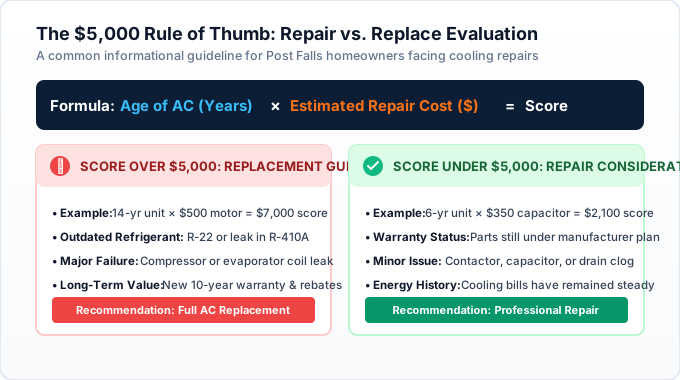
When an air conditioner breaks down, homeowners frequently struggle to decide whether a costly repair makes financial sense or if replacing the system is the wiser investment. Heating and cooling specialists across North Idaho often reference the $5,000 Rule as a practical rule of thumb—an informational guideline used by homeowners and technicians, not an official industry mandate.
Multiply the age of your air conditioning unit (in years) by the total estimated repair cost quoted by an HVAC technician. If the resulting figure is greater than $5,000, investing those funds into a modern, warrantied replacement is generally the sounder financial strategy.
For example, spending $800 to replace a condenser fan motor on a 14-year-old system yields a score of $11,200 (14 × $800), well above the replacement threshold. Conversely, spending $350 on an electrical capacitor for a 5-year-old system equals $1,750 (5 × $350), meaning repair is usually appropriate.
Actual AC replacement costs vary depending on equipment, home size, installation complexity, ductwork, electrical requirements, permits, equipment efficiency, and contractor pricing.
Cooling Replacement Options for Post Falls Homeowners
Technological advancements in the HVAC industry give homeowners several distinct equipment categories when replacing an older cooling system.
Standard Split Central Air Conditioners
The most common replacement for homes with existing forced-air furnaces. A dedicated outdoor condensing unit operates alongside a matched indoor A-coil. Modern models meet Northern regional standards at 13.4 SEER2, providing reliable, straightforward cooling for single-family residences.
Explore Central AC Replacements →High-Efficiency Two-Stage AC Systems
Two-stage cooling systems operate at a lower capacity (around 65-70%) during mild summer days, shifting to 100% capacity only during peak July heat. This creates longer, quieter cooling cycles that provide superior indoor humidity control and balanced temperature across two-story layouts.
View Community System Upgrades →Cold-Climate Heat Pumps (Dual-Fuel Hybrids)
Heat pumps provide both air conditioning in the summer and reverse-cycle heating in the winter. Paired with your existing natural gas furnace in a "dual-fuel" configuration, a heat pump handles cooling and moderate winter heating, switching to gas only when temperatures plummet below freezing.
Learn About Heat Pump Replacements →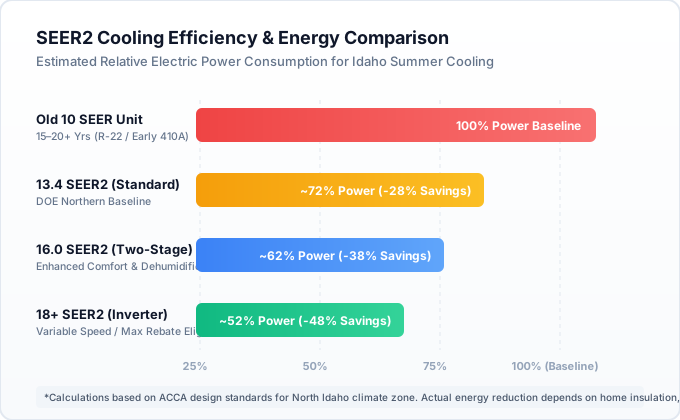
Understanding SEER2 Ratings in Idaho
In 2023, the U.S. Department of Energy instituted the SEER2 (Seasonal Energy Efficiency Ratio 2) testing standard. The updated M1 testing protocol accounts for real-world external static duct pressure (0.5 in. w.g. vs 0.1 in. w.g. under the old metric), offering a much more realistic picture of equipment efficiency inside actual residential duct systems.
In Idaho (Northern Region), the statutory minimum for split-system air conditioning installations is 13.4 SEER2. Upgrading from a 15- to 20-year-old 10-SEER system to a modern 13.4 or 16+ SEER2 unit can reduce seasonal cooling electrical consumption by 28% to nearly 40%.
Furthermore, beginning in 2025 under the EPA AIM Act, newly manufactured equipment transitions to low-GWP (Global Warming Potential) A2L refrigerants such as R-454B. When you replace an older system, an independent contractor ensures all components, safety controls, and line sets conform to these latest standards.
How Homeowners Connect with Local Providers
We believe in making the process of researching and scheduling cooling replacements simple, clear, and pressure-free.
Place a Direct Call
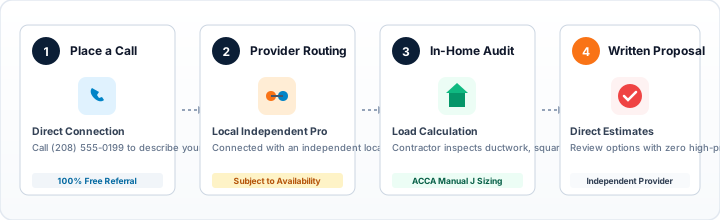
Dial (208) 555-0199 to reach our referral dispatch desk. Share your home's location, current system symptoms, and preferred timeline.
Provider Connection
Depending on real-time availability in Post Falls, your call is connected directly with an independent local HVAC contractor licensed in Kootenai County.
In-Home Assessment
The matched contractor visits your residence to inspect existing ductwork, measure square footage, and perform an ACCA Manual J cooling load calculation.
Transparent Proposal
Receive written, itemized replacement options covering equipment tiers, labor warranties, and utility rebate qualifications with zero high-pressure sales.
Serving Post Falls & Surrounding Kootenai County
From established subdivisions to newer master-planned developments, local heating and air conditioning professionals serve neighborhoods throughout the Post Falls area.
Montrose
West Post Falls master-planned neighborhood featuring homes built from the late 1990s through the 2010s. Many original cooling units are currently approaching or exceeding their 15-year service life.
Explore Montrose AC services →Tullamore
Centrally situated off Prairie Avenue, Tullamore encompasses single-family homes, cottages, and villas with a strong emphasis on energy efficiency and modern heat pump conversions.
Explore Tullamore AC services →The Highlands
Scenic golf course community north of I-90 with larger custom properties, elevated sun exposure, and multi-story floor plans requiring precise zone control and dual-capacity equipment.
Explore The Highlands AC services →Fieldstone
Sprawling family community in central Post Falls with over 320 acres of single-family residences where standard split-system central air conditioning replacements are widely needed.
Explore Fieldstone AC services →Also assisting residents across the Rathdrum Prairie corridor, Greensferry, Spokane River basin, and adjacent North Idaho locales.
Common Questions About Post Falls AC Replacement
Straightforward answers to the questions Post Falls homeowners ask most when evaluating cooling system options.
How do I know if my air conditioner needs replacement instead of repair?
Common indicators that an AC unit is ready for replacement include equipment age over 12-15 years, escalating repair frequency, the use of phased-out R-22 refrigerant, uneven cooling across rooms, and repair estimates exceeding the "$5,000 Rule of Thumb" (an informational guideline used by homeowners and technicians, not an official industry mandate, where the unit's age in years is multiplied by the repair cost; if the result exceeds $5,000, replacement is typically recommended).
What is the typical lifespan of a central AC system in Post Falls, Idaho?
In North Idaho, where cooling systems operate intensively during summer heat waves (July and August) and sit idle or handle modest shoulder season tasks, a well-maintained central AC system typically lasts between 12 and 17 years. Systems exposed to heavy dust or neglected air filters may degrade sooner.
What are the new SEER2 efficiency regulations in Idaho?
Under Department of Energy regulations for the Northern region (which includes Idaho), newly installed split-system air conditioners must meet a minimum efficiency standard of 13.4 SEER2 (roughly equivalent to 14.0 under the older SEER testing scale). Modern systems range from 13.4 up to 20+ SEER2 for premium variable-speed equipment.
What happens when I call your Post Falls number?
When you call (208) 555-0199, you are directly connected with our referral service. Based on local contractor availability in Post Falls and Kootenai County, you will be routed to an independent local HVAC professional who can discuss your cooling needs, answer equipment questions, and schedule a no-obligation in-home assessment.
Can I replace my AC unit and keep my existing furnace?
Yes, in many cases an independent technician can replace just the outdoor condensing unit and matched indoor evaporator coil while keeping your existing furnace. However, if your furnace is over 15 years old or uses an older single-speed blower motor, replacing both systems simultaneously often saves on labor costs and helps ensure proper airflow matching for SEER2 compliance.
How does an ACCA Manual J load calculation impact my replacement?
Under Idaho state mechanical codes, HVAC equipment must be properly sized using an ACCA Manual J calculation rather than relying on rough "rules of thumb" based solely on square footage. Manual J evaluates your home's orientation, insulation R-values, window glass area, ceiling heights, and local outdoor design temperatures (-1°F winter, 89°F summer) to ensure your new system is neither undersized nor oversized.